
GARDEN BLOG - MAY 2026
The arrival of May has, for many millennia, been a time of celebration at the arrival of summer.
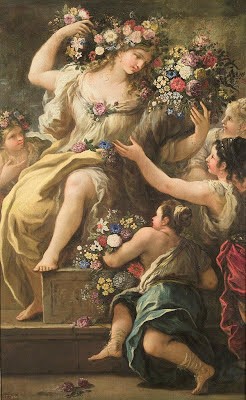
In ancient Rome, a six day festival of licentious pleasure-seeking, called Floralia, was held to honour the goddess Flora. Among the activities laid on for the flower garlanded to enjoy, were theatrical performances and circus routines; and the ritual release of hares and goats, which were considered fertile, while the attendant crowd were pelted with legumes.
In the Gaelic world, the arrival of May was marked by Beltane. Wild blossoms decorated the doors and windows of houses, while great bonfires were lit to bestow protective powers on livestock and their herders.
By medieval times, the arrival of May was celebrated with feasting and dancing in towns and villages across the British Isles. Over time, a host of exuberant traditions developed to mark the day, such as dancing around the maypole to weave long ribbons into intricate patterns, and garlanded May Queens presiding over affairs. May Day as we know it was born. Unrelated to the Christian calendar and closely related to fertility rituals, not everyone has been a fan of May Day. The most comprehensive campaign against it was waged during the rule of Oliver Cromwell, when his puritanical fanaticism led to it being banned. However, with the restoration of the Crown came the restoration of May Day.
Putting on their own exuberant celebration, marking the arrival of May, are bird cherry, hawthorn, and horse chestnut, growing in our Wild Gardens. These three trees blessed with billowing clouds of frothy, pure white flowers in May, along with the herbaceous perennial, cow parsley. Together, they fill the air with their deep and intoxicating scent. As dusk falls, the whole ensemble takes on a feeling of eerie ghostliness.
Cow parsley, or Queen Anne’s lace, is also known in these parts as keck, and has some interesting folklore. The most dramatic of all is it being known in some circles ‘mother die’, a name used to frighten children into believing that picking the flowers would result in the death of their mother. Of course, picking cow parsley had no such effect. This overly dramatic moniker was intended to deter children from mistakenly picking highly poisonous hemlock and, if they somehow ingested it, ending up dead themselves.
From the gardeners point of view, cow parsley is generally seen as something of an invasive pest, a weed to be dealt with without a second thought. That said, there is a popular cultivated version of cow parsley, Anthriscus sylvestris 'Ravenswing’, that has purple foliage, and has managed to gain acceptance in even the haughtiest and finickiest of gardening circles. In our wild gardens, where British native flora is positively encouraging, we take a very laissez-faire approach where cow parsley is concerned, and allow it to flourish unmolested.
Meanwhile, back in the formal gardens, such likes as roses, iris, alliums, wisterias, and a host of others, bring a riotous explosion of scent and colour to tantalise the senses. A most extraordinary sight among them is a man-made creation, a small deciduous tree named +Laburnocytisus adamii. Producing a highly curious melange of yellow, purple, and soft pink flowers, all on one tree, this bizarre behaviour is the upshot of it being a graft-chimera. In a normal graft, the rootstock and scion are united but remain distinct from each other, however, in exceptionally rare circumstances a graft-chimera occurs, in which the cells of both parts mix and merge to create a single, highly idiosyncratic plant. Because of the manner in which these trees are created, each +Laburnocytisus adamii has an utterly unique appearance.
As beguiling as +Laburnocytisus adammi is, us gardeners can’t spend too much time admiring its charms, as May is a very busy time where our seasonal displays in our pots, tubs, and urns, are concerned. Out go the winter displays to be replaced by summer. Mature perennials such as our brugmansias, cannas, and Ethiopian black banana, have returned nicely into growth over the last few months, and are now big enough to make an impact outdoors again as specimen plants in our larger displays. Cuttings taken towards the end of last year, such as fuchsias, salvias, and heliotrope, are now mature enough to join them. Also set to liven up the summer displays are half-hardy annuals grown from seed, most prominent among these are numerous varieties of love-lies-bleeding, in a range of colours and forms.
It’s important to ensure that plants grown under cover are hardy enough to survive happily outdoors at this time of year, before planting them out. This is done by ‘hardening off’ or placing plants outdoors in a sheltered position for a few days before planting to toughen them up a little. It’s essential, however, that these plants are protected from frost. Therefore, if frost is forecast, it’s advisable to put off planting out till a later date.
Having observed the traditions of May Day, and worked hard in our gardens since then, we can see the month out with Spring Bank Holiday, and another well earned rest.
Until next month, happy gardening.
The goddess Flora
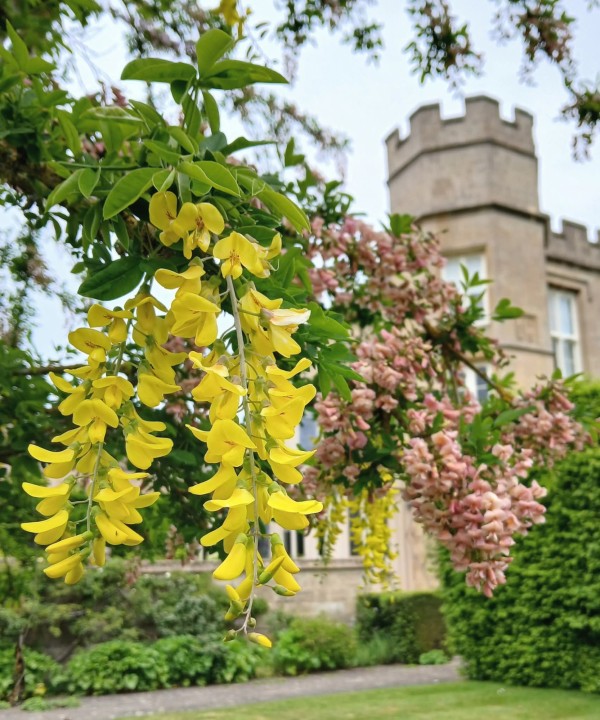
Laburnocytisus adamii
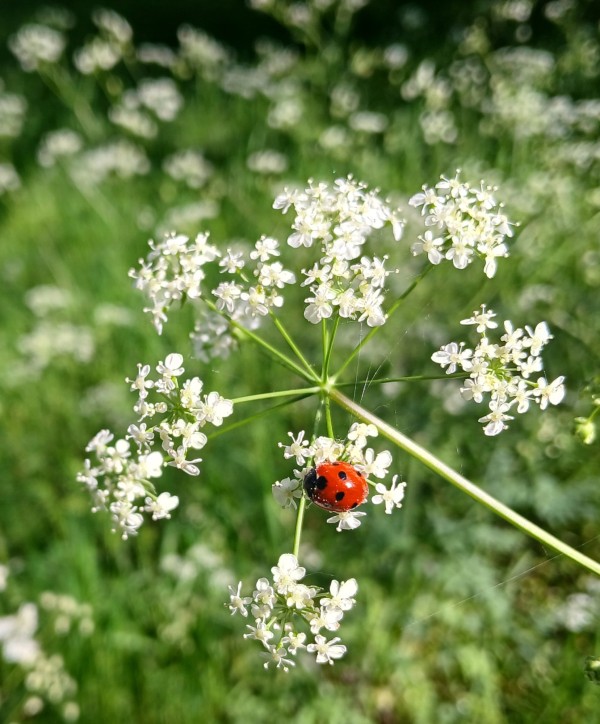
Cow parsley and a seven spot ladybird
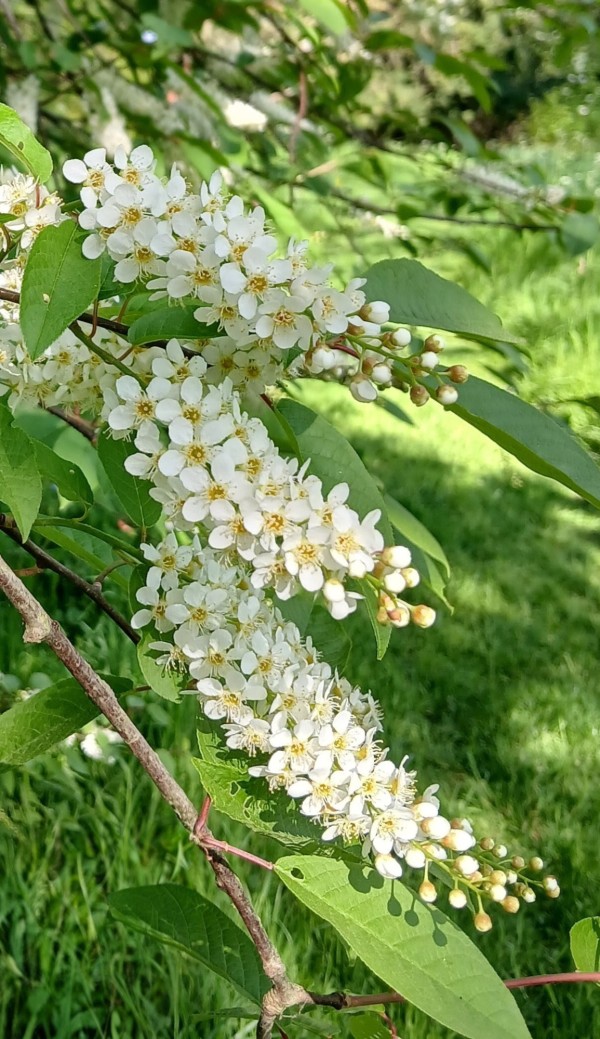
Bird cherry