
GARDEN BLOG - JULY
As the old adage says...
Whether the weather be cold,
Or whether the weather be hot,
We'll weather the weather,
Whatever the weather,
Whether we like it or not!
So far this summer we’ve weathered the blisteringly hot, and with El Niño on its way there may well be more to come. Of course, El Niño is known for creating extremes of weather, so maybe that’s what was behind the legend of St. Swithin.
An Anglo-Saxon Bishop of Winchester from 852 until his death in 1863, St. Swithin specified before his death that he wished to be buried in the great outdoors, so that "the sweet rain of heaven" could fall on his grave. This is exactly what happened. All was fine and dandy, until a little over a century later, on July 15th, 971, his remains were dug up and transferred to a shrine built in his honour inside Winchester Cathedral, and a terrific storm followed that lasted for forty days and nights. People said that the saint in heaven was weeping, because his bones had been moved. That’s quite a weep.
This brings us on to our second old adage…
St Swithin's Day if it does rain,
Full forty days it will remain,
St Swithin's Day if it be fair,
For forty days t'will rain no more.
This particular old adage has so far proved to be bunkum. Since weather records began in Britain, there has never been a recorded instance of forty consecutive days of rain or dry weather immediately following July 15th. But who knows, El Niño may change all of that.
In honour of St. Swithin, we have a Winchester Cathedral rose growing in our Long Borders. It’s a particularly beautiful, scented, pure white rose, that has, along with the others here, put on a sterling show throughout the early summer this year.
Among other plants doing their thing right now, to beautify our gardens, are great stands of stately hollyhocks. Known to botanically minded folks as Alcea rosea, hollyhocks are short lived perennials, introduced into Europe from southwestern China in Medieval times. Thriving on free-draining soils in full sun, hollyhocks self-seed freely when happy in their environment. The name ‘holyoke’, as it was originally spelled, was first mentioned by the English herbalist, William Turner, in his ‘Newe Herball’ of 1551. Holyoke meant ‘holy mallow’, which no doubt relates to their flower spikes rocketing skywards towards heaven. Since then, the name has gently morphed into the hollyhock that we know today. John Parkinson, in his ‘Thaeatrum Botanical’ of 1640, wrote that hollyhock leaves could be either boiled or eaten raw as a purgative. While in 1861, Robert Bently, in his ‘A Manual of Botany’ told us that the leaves could be used to produce a blue dye, and stem fibres to produce rope. Few gardeners are particularly fussed about purging, dying, or rope making, our hollyhocks are purely ornamental, valued for their disk -like flowers in shades from pure white, cream, and pale yellow, through pinks, reds, and maroon.
Also going great guns right now, are the pots and urns planted up at the end of May. Of course they require regular watering and feeding to keep them at their very best, but the effort is worth it, as they provide plentiful colour, and a thoroughly tropical feel, whatever the weather.
Elsewhere, it wouldn’t be July without us tackling the job of clipping our yew topiary teapots, hornbeam hedges, and Rose Garden beech sentinels, ensuring that our formal areas remain exactly that.
Finally, July sees the departure, due to his retirement, of our Assistant Gardener, Mark. Having been with us for six years now, Mark will be sorely missed, not only because of his dedication to the gardens, but for his unwaveringly jovial nature, gaining him the epithet ‘Cheerful Mark’.
We wish Mark the very best for a relaxed retirement tending his allotment.
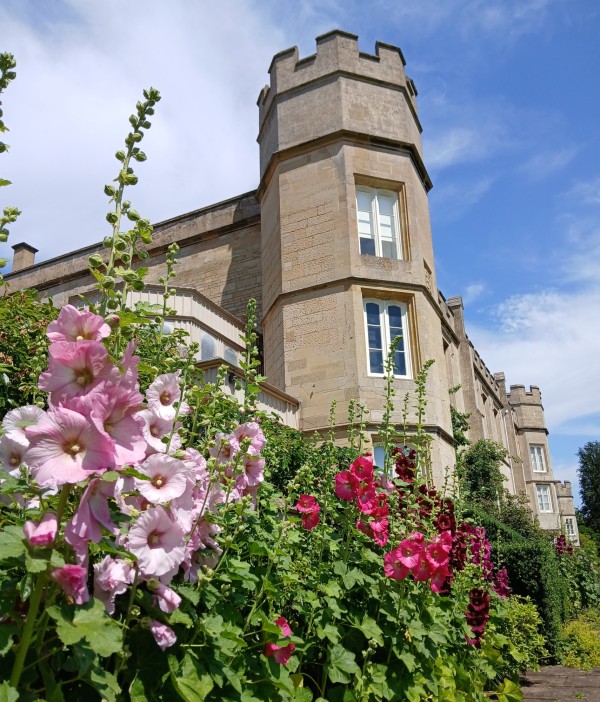
Hollyhocks
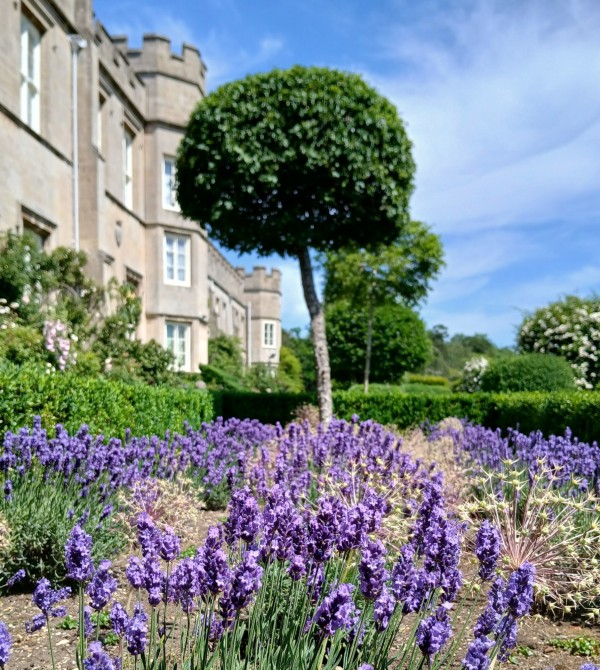
Clipped hawthorn, lavender Hidcote, and Allium christophii seed heads
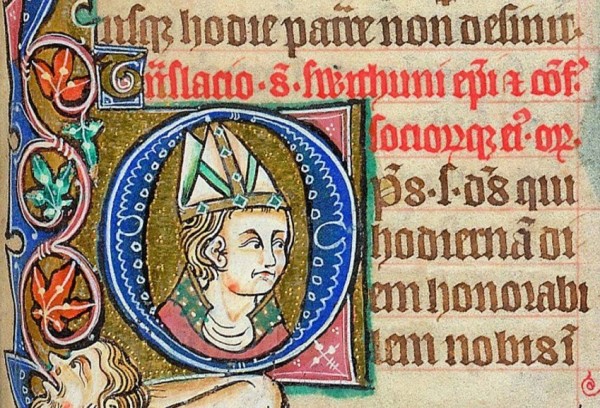
St Swithin
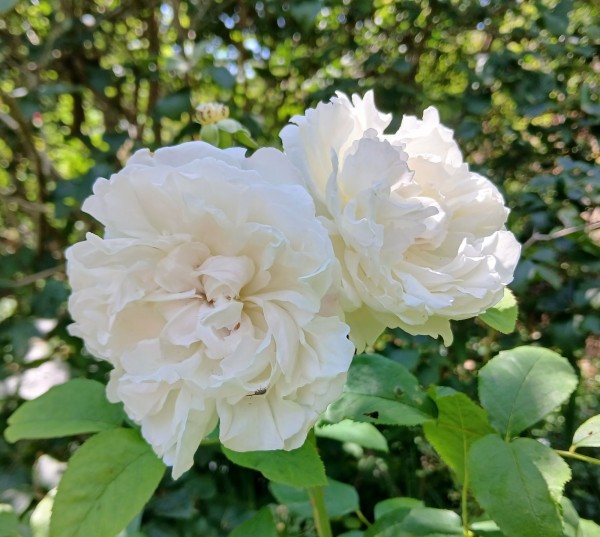
Rose Winchester Cathedral