
GARDEN BLOG - JANUARY 2026
Here we are in a new year, and the seasonal festivities of late are now well and truly behind us. For some this might seem like a comedown, after consuming their own bodyweight in turkey, mince pies, mulled wine, and indigestion tablets, but not for us gardeners. For even though the year began with a dusting of snow and harsh frosty weather, we see brighter times ahead.

January is a month that offers up a tantalising glimpse of new beginnings, transition, and renewal. Days are now lengthening as Mother Nature gently yawns and stretches back to life, while the cycle of seasons rolls inexorably on.
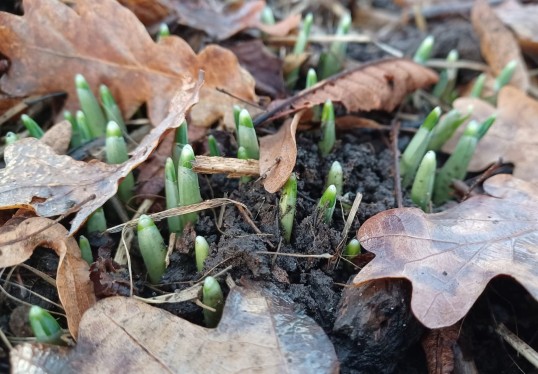
To prove the point, pure white snowdrops and golden winter aconites push up through the soil, carpeting the previously barren soil with their cheery blooms. Above them, witch hazels, viburnums, and winter-flowering honeysuckles, not only offer up their flowers, but fill the air with their heady scent to boot.
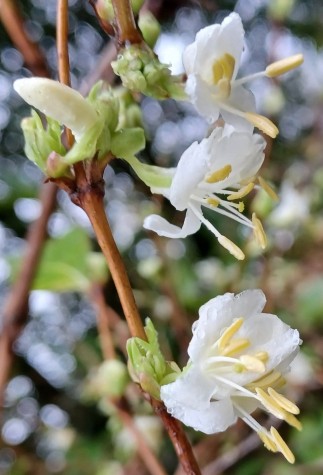
Winter-flowering honeysuckle, known to botanically minded types as Lonicera x purpusii, is a medium sized deciduous shrub that originated as a cross of garden origin between two Chinese species, L. fragrantissima and L. standishii. The dainty flowers are strongly fragrant with the typical honeysuckle scent, creamy white in colour, and held in pairs on naked branches. It is extremely hardy, and tolerates a wide range of soil conditions. Besides being grown in the usual way as a specimen shrub, winter-flowering honeysuckle makes a splendid scented hedge.
Looking and planning ahead are central to successful gardening, and with that in mind it’s now time to peruse the seed catalogues, tea and biscuits at hand, sat in your comfiest armchair, searching out old favourites or something new to try. Of course, besides being highly rewarding to grow your own plants from seed, it’s undoubtedly much more cost effective than buying the same plants from a garden centre or nursery.
Heading out into the garden, January sees us complete our rose pruning endeavours, and turn then to the fruit trees in our Wildflower Orchard. We have a selection of free-standing apples, pears, and quinces, along with espalier trained apples grown against railings.
When pruning free-standing trees, the aim is to create an open goblet shaped canopy, to allow air and sunlight in. This is done by maintaining three or four main branches, that have their new growth pruned by a third until the tree reaches its desired height. Other new growth that is heading towards the centre of the goblet, is crossing, diseased, or damaged, should be removed completely.
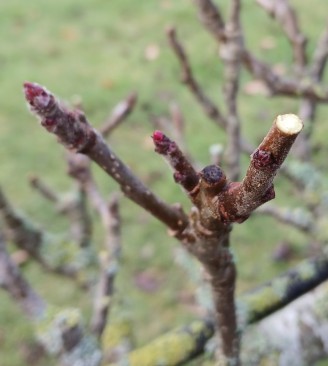
The new growth that remains should be pruned back to three or four buds from their base. 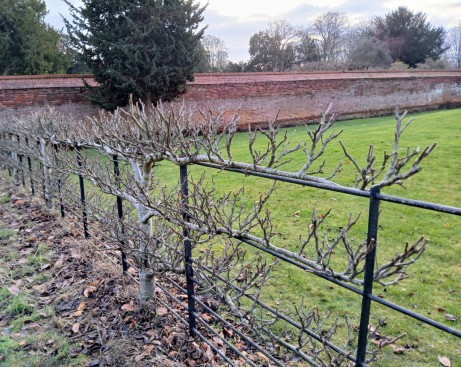
The basic principle where training espalier fruit trees is concerned is about selecting branches to train horizontally, in tiers that are approximately 45cm apart. These horizontal branches will then produce numerous vigorous vertical branches, which must be pruned back to within three or four buds from their base to encourage shorter, flowering, spur branches, until, eventually, little pruning is required at all.
As ever, next month, we will have our first garden openings of the season to celebrate the arrival of our snowdrops, details of which will be in the February blog. Naturalised snowdrops cover several acres of our Wild Gardens and managed ornamental woodlands that surround the formal gardens to the north of the lake and canal. Meanwhile, planted in beds close to the house, an ever-increasing collection of unusually named snowdrop varieties can be seen close up.
Until next month, happy gardening.